PointDiT: Pixel-Space Diffusion for Monocular Geometry Estimation
ICML 2026
A minimalist pixel-space diffusion transformer that predicts dense 3D point maps from a single image, with no VAE and no hybrid architecture.
Researcher at KE:SAI Open Science Lab
Postdoc at ETH Zurich

I am a researcher at KE:SAI Open Science Lab and a postdoc at ETH Zurich, advised by Andreas Geiger and Marc Pollefeys.
I received my PhD from ETH Zurich under the supervision of Marc Pollefeys and Andreas Geiger. During my PhD, I interned at Google, where I worked with Michael Niemeyer and Federico Tombari. Previously, I worked with Jianfei Cai and Hamid Rezatofighi at Monash University. I earned my master's degree from University of Science and Technology of China, where I worked with Juyong Zhang. During my master's, I also studied as an exchange student at NTU and completed a research internship at Microsoft Research Asia.
I am honored to have been named a 2025 Apple Scholar in AI/ML. I also received the Gold Reviewer Award at ICML 2026, the Top Reviewer Award at NeurIPS 2024, and the Outstanding Reviewer Award at CVPR 2022.











I build simple, scalable models for 3D vision. My work spans dense correspondence (GMFlow, UniMatch), point tracking (MegaFlow, MVTracker), feed-forward Gaussian splatting (MVSplat, DepthSplat, NoPoSplat), learned optimization for test-time scaling (ReSplat), and pixel-space diffusion for geometry (PointDiT). I now work on representation learning and generative models for efficient, scalable world models and physical AI.
A minimalist pixel-space diffusion transformer that predicts dense 3D point maps from a single image, with no VAE and no hybrid architecture.
Test-time scaling for feed-forward Gaussian splatting.
A simple yet powerful framework for large-displacement optical flow and point tracking.
The first data-driven multi-view 3D point tracker for tracking arbitrary 3D points across multiple cameras.
Cross-task interactions between feed-forward Gaussian splatting and depth.
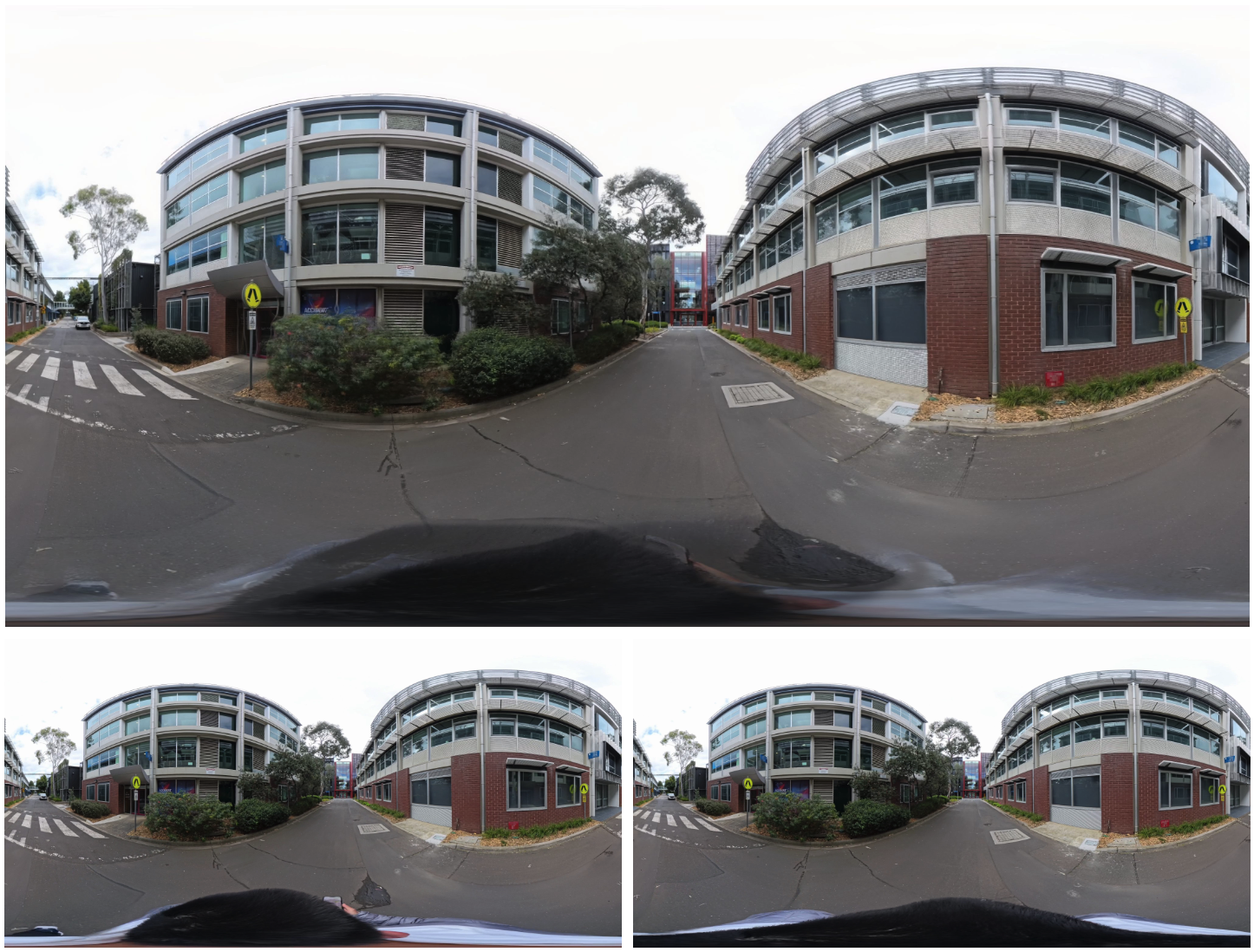
4K panorama synthesis with a single feed-forward inference.
Unposed 3DGS reconstruction made easy.

A cost volume representation for efficiently predicting 3D Gaussians from sparse multi-view images in a single feed-forward inference.

A unified dense correspondence matching formulation enables three motion and 3D perception tasks to be solved with a unified model.


Factorizing 2D optical flow with 1D attention and 1D correlation enables 4K resolution optical flow estimation on standard GPUs.

A sparse points-based cost aggregation method leads to an efficient and accurate stereo matching architecture without any 3D convolutions.